Stocking Up

I went through a phase of making my own soup stock, but my interest waned along with my enthusiasm for soup. Well, there’s been a resurgence on both fronts.

When I recently found myself making more soups and stews, I thought it was high time to reintroduce the practice of setting aside veggie skins, scraps and the like for stock making.
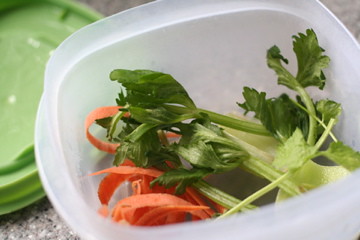
The process really couldn’t be much easier. I’m keeping a plastic container in the freezer, and every time I do a little peeling, trimming or cutting, I toss in the remainders. It’s also a nice repository for the wilted herbs (not ones gone bad) and the (literal) odds and ends we’re not going to use.

Turning scraps to stock is a better use of resources (natural and monetary) than composting these materials. After all, you’re using unwanted items to help create desired ones (provided your cooking is at least passable). Besides, you can still compost the solid remains afterward.

And as a bonus, making vegetable stock makes me feel less guilty about peeling my carrots. [Note: I've stopped peeling the local ones from the farmers' market.]

Since I’m far from an expert on the topic, are there any tips/strategies you’ve found helpful for making vegetable stock? Any no-no’s?

This entry was posted in Household, Personal and tagged , , , , , , , . Bookmark the permalink. Post a comment or leave a trackback: Trackback URL.

12 Comments

  1. Posted January 26, 2011 at 7:59 am | Permalink

    I fail at this…my scraps usually go straight into the compost bin.

  2. fireweed
    Posted January 26, 2011 at 9:12 am | Permalink

    Don’t put in cabbage family remains if you don’t like a strong flavored stock. I also keep the remains of small chickens that I have baked, until I have enough to make chicken stock.

  3. Sarah
    Posted January 26, 2011 at 9:46 am | Permalink

    I do this – it works fairly well. Onion skins add excellent flavor to stocks! We also buy the roaster chickens a lot (my husband has one of those rotisserie things you see on tv all the time) – and those are the perfect size to put in a crock pot after we eat it. I usually just through the carcus in the crockpot at night, cover it with water and whatever else we have around, and then by morning there is chicken stock.

  4. arlani
    Posted January 26, 2011 at 10:14 am | Permalink

    I don’t recommend including turnip skins–like fireweed, I found that they made the stock too strong and bitter to use.

  5. Bellen
    Posted January 26, 2011 at 11:48 am | Permalink

    I’ve found that roasting veggie scraps, minus strong tasting ones, makes for a stronger tastier stock. Also gives it great color. I toss the scraps with olive oil before roasting, about 1 tablespoon to 2 cups scraps, at 350 for about 1 hour or until edges turn brown and you can see the caramelization starting. Then cover with water and do the crock pot or the solar oven for several hours. Strain, put into quart canning jars, refrigerate, remove the fat that has risen to the top and freeze.

    Also make stock from chicken carcasses, wing tips, and trimmings. Same for beef stock – bones and trimmings. I also roast these for about an hour, then add water to cover. Again, crock pot or solar oven for several hours. Strain, refrigerate, defat, freeze.

  6. Posted January 26, 2011 at 1:38 pm | Permalink

    Kristen–I wouldn’t use the word ‘fail.’ Maybe that you’ve been biding your time…waiting for all this excellent advice to come in!

    Speaking of which–thanks everyone for the tips thus far. No to cabbage and no turnip peels. Yes to onion skins and roasting. Got it.

    I have made chicken stock a bunch and wholeheartedly agree that it’s a great use for the carcass.

  7. Posted January 26, 2011 at 5:56 pm | Permalink

    I’ve been making stock for years. My latest additions:

    1) In the past, I would freeze the batch of stock in a giant tupperware, but found that not handy because I don’t want to defrost the huge chunk when I need small batches of stock (for sauces, etc.). Now I either freeze small amounts of stock in canning jars w/o the lid, or freeze stock in ice cube trays. It’s also easier to find room in the freezer for smaller containers vs. large ones.

    2) if you have extra fatty stock (like from leftover thanksgiving turkey), I also freeze the fat and then use it to roast potatoes — which tastes soooo amazing.

  8. Posted January 26, 2011 at 8:47 pm | Permalink

    I am kicking myself about this – I made chicken stock last night, and I realized as I threw the half onion into the compost that I could have saved them the same way I saved the rest of the chicken meat bits for a pot pie.
    I also really want a fatty stock now – fat and potatoes? Best idea ever!
    Decadent Philistine

  9. Jennifer
    Posted January 27, 2011 at 7:53 pm | Permalink

    I make stock every few weeks. My neighbor works for a major chicken company and can get me large amounts of chicken for a very low price. Every time I get chicken with bones I immediately think stock.Last week I made a large supply and added some fresh herbs. I used it to make soup this week and it was very aromatic and so much cheaper than buying stock. I don’t even like store bought stock/broth any more.

  10. Posted January 27, 2011 at 8:00 pm | Permalink

    We don’t make stock often, but love it when we do. Parsley stems and celery leaves add nice flavor, broccoli, kale & chard, not so much. I’ll save those leftover items to put IN the soup once the stock is made.

  11. TOAST
    Posted January 27, 2011 at 10:34 pm | Permalink

    Protip: If you buy your milk in cardboard cartons, use those and keep in the freezer. They stack well. Then when you want to make stock, take one or several out, rip the cardboard off and go for it.

    Also an added reason to buy whole chickens instead of portions/breasts
    1) Cheaper
    2) Positive ethics of “nose-to-tail” eating
    3) Freeze carcasses for stock.

  12. Kate Hillier
    Posted January 30, 2011 at 6:31 am | Permalink

    I simply keep the juices that the vegetables have been cooking in an recycle for delicious veggie stock!!
    I also periodically make chicken stock when I roast chicken.
    I believe in making homemade stocks.

Post a Comment

Your email is never published nor shared. Required fields are marked *

*
*

You may use these HTML tags and attributes: <a href="" title=""> <abbr title=""> <acronym title=""> <b> <blockquote cite=""> <cite> <code> <del datetime=""> <em> <i> <q cite=""> <strike> <strong>

  • Buy the Book

    CBA Winner Badge