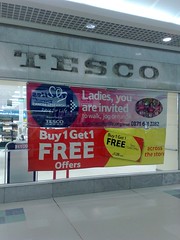
Yesterday, UK Prime Minister Gordon Brown fanned the food waste flames via comments to the media.

Brown, the former Chancellor of the Exchequer, showed his financial stripes in saying that food waste was partly due to “unnecessary demand.”

If we are to get food prices down, we must also do more to deal with unnecessary demand, such as by all of us doing more to cut our food waste, which is costing the average household in Britain around £8 ($16) per week.photo by BuhSnarf

The response was swift and negative, as exemplified by this well-crafted column. Don’t blame supermarkets or so-called “bogof” (“buy-one-get-one-free”) promotions for food waste, grocers, shoppers and columnists retorted. ‘Mind your own business,’ bloggers wrote. (A common thread being the easy, effective pun of telling Brown to “bogof.”)

Let’s be clear: Deals that push shoppers to buy more food than they need are partly to blame for food waste. Yet that’s only a small part of the picture.

Still, it’s a bit odd for the Prime Minister of Britain to denounce a private-sector promotional tactic. It also makes him an easy target, as the people struggling to cope with rising food prices are the ones most likely to take advantage of the deal (without wasting food). And it wasn’t shrewd for Brown to scold supermarkets and citizens about waste and rising food prices as he was flying to a lavish G8 Summit with $395 (£200) per head, 8-course dinners.

All the media attention on “unnecessary demand,” however, absolves the main culprit–us. Sure, supermarkets could help reduce waste by not tempting us into buying more than we need, but we’re the ones deciding to buy two heads of lettuce for the price of one when we know we can’t finish one before it starts rotting.

To reduce food waste, it’d be more effective if everyone focused on the second part of Brown’s sentence: “All of us doing more to cut our food waste…”


Comments

7 responses to “Blame Game”

  1. Katherine Avatar
    Katherine

    My mother always taught me that if I don’t need it and/or can’t afford it, it is not a good deal. No store forces you to take the second, “free”, head of lettuce. While I may pay a higher unit price for smaller packages, I still spend less and waste less overall.

  2. I think when it comes to promotions – something i do is figure out if it can be frozen – like extra bread or bags of milk. or even some veggies – i’ll steam or cook them, then freeze them for later use. No waste.

    Yes i know things can get lost i the freezer. that is why once i month, i go through it. pull stuff out to the front that is getting “burried” under some bigger items (like the bags of milk).

  3. Interesting Jonathan, but it was when I read the attached article in the Independent that one sentance jumpted out

    “Perhaps it has also escaped the Prime Minister – despite his celebrated attention to detail-that the vast majority of “Bogof” deals in supermarkets are for goods which can be frozen”.

    This is news to me and as supermarkets advertise in that paper (I am a suspicious individual) I called in when passing my local Tesco’s to check this info out. The ‘Bogof’ deals were as follows:

    5 varieties of chocolates
    10 varieties of crisps
    7 varieties of cook in sauces
    Pepsi Max
    Lucozade (an energy drink)
    1 fruit drink concentrate
    1 type of biscuit (cookies)
    1 brand of 4 tin pack tomatoes
    1 type of tea bag
    1 type of drinking yoghurt

    No frozen food at all, in fact I could find no essential food items on ‘Bogof’ deals. This was a snapshot rather than research over a period and I have seen these offers on vegetables in the past but the present deals seem, in the main, to be a health hazzard problem rather than a food waste problem.

    Perhaps the author of the article was unwilling to bite the hand that feeds?

    Blessings,

    Peter.

  4. Jonathan Avatar
    Jonathan

    That’s some nice research, Father Peter. There is certainly plenty of crossover between food waste and poor eating habits and you’ve identified another one.

    You’re right that “BOGOF” promotions with non-perishable or freezable items, although probably less healthy, leads to less waste. Still, these items are often lost in our pantries or freezers. And then the savings evaporate.

    On a separate note, when we freeze certain items, we sacrifice quality and taste for savings. Whether that’s worth it is an individual decision.

  5. Bogof offers might be there to get you in the store, get you to try a new product, or just to get rid of excess stock. In that last case they probably result in less food being thrown away. Whatever, supermarkets know best how to run their businesses efficiently. And how much food is thrown away is only a small part of the picture. Coping with peaks of demand, and being able to get rid of stock when an expected peak failed to appear is another part. Meddling in the tools supermarkets use to tweak demand is a recipe for empty shelves.

    As for “us” being the main culprit? Culprit of what. There’s nothing inherently wrong with throwing away food.

    When individuals throw food away it is *not* waste. It was bought for a reason: to make sure you had enough; because you didn’t know in advance how hungry you were going to be, or whatever. When you throw food away, that’s money you could have saved. But you didn’t save it. It cost you money. But you *have* bought something with that money.

    You bought not having to spend an hour working out exactly how much food you needed. You bought not having to eat food you didn’t feel like eating. You bought having an impressive spread at the dinner party even though everyone was too full to finish it. You traded money for a slightly more pleasant life.

    Having politicians control the myriad tiny day to day decisions and trade-offs we make is a recipe for a tedious, miserable life. We should not allow them even to voice an opinion on such matters, lest they get ideas about control.

  6. Sorry Rob, but in my book throwing away food is wrong. Food you waste for your ‘impressive spread at the dinner party’ pushes up the price of food for those least able to afford it.

    Many don’t have the luxury of not having to worry about ‘spending an hour working out exactly how much food they need’, They can’t overbuy and dump the remains in landfill.

    Your are indeed in a happy position if you have excess money you can trade in for your life style.

  7. “The Blame Game” is a feature of British attitudes.
    Politicians blame superstores, superstores blame consumers, councils, councils blame consumers, government. It is the standard way to shift responsibility.
    My attitude, along with fellow Zero Waste enthusiasts, is to take up the challenge and do our own Zero Waste thing and encourage others to join in.
    My 156 week binbag is a blow for sustainability and against landfill. Worldwide the message is gaining strength with millions of links in a Google search. The trend is only one way and the sadly deluded landfill advocates are swimming against the tide.

    John.