Fresh Brewed Waste?

You’re all probably familiar with the Keurig one-shot coffee machines. They’re pretty handy, I suppose. Well, one rationale for these machines that I can appreciate is that they prevent offices (and homes) from wasting pots of coffee.

I usually focus on food waste–not beverages–but coffee dumping seems so egregious. Most cafes, restaurants and convenience stores dump massive amounts of “joe” each day, usually in the name of freshness. Apparently, at Starbucks a new vat arrives every 30 minutes.photo by midnight glory via creative commons
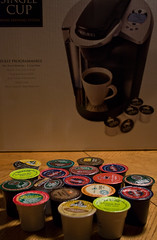
That’s why I applaud the one-cup notion, in general.

BUT…in this era of environemental consciousness, there are always trade-offs (unless you’re talking about removing trays from cafeterias). In this case, the benefit of less unused coffee combats the negative of abundant packaging. All those little “K-Cups” pile up, as do the boxes that house them.

Making things worse, it’s not easy to recycle these K-Cups because only the foil top is recyclable. You could always get a reusable K-Cup filter, but not many people will. I know Green Mountain Coffee is trying, as well they should because K-Cup purchasing has almost quadrupled from 2002 to 2006. Here’s their take on the topic:

We are now producing more than 3 million K-Cups each week and the environemental impact of the K-Cup waste stream we generate is among the most significant environmental challenges we face.

Another factor is the energy used in making a pot of coffee compared to a bunch of K-Cups. I wonder if the law of diminishing returns applies there. Anyway, I know many of you are passionate about coffee–what’s your take on this topic?


Comments

10 responses to “Fresh Brewed Waste?”

  1. I find these systems extremely wasteful. While I’m more of a tea drinker than a coffee drinker, we have started brewing coffee at home, and put it in mugs and thermoses for work. The thermos I use keeps drinks hot for hours; I can brew my drink in the morning and have it hot with lunch. I know some people really want fresh coffee, but there are ways to manage.

  2. Alastair Scott Avatar
    Alastair Scott

    A similar system is Nespresso. Its “pods” are completely unrecyclable because they are all-foil and robustly built; break them apart – with some force required – and you spread wet ground coffee all over the place, which is hopeless.

    On the other hand, no coffee is wasted and the brew cycle is extremely short – a couple of minutes from cold, maximum.

    Environmentally, it is six of one and half a dozen of the other I think; financially, you pay considerably less for the machine (simpler mechanism?) but make the saving up over time with the cost of materials.

    But the pod system has an unusual advantage – a friend with slight cerebral palsy notes that standard coffee machines are so awkward to fill and clean they are completely unusable, whereas pod machines are no problem!

  3. New to your blog, but just had to comment! These darn things drove my thrifty recycling self crazy until I figured out a way to re-use them. Now I collect them from all the offices in my building. The coffee grounds go into my garden, and the little cups are used for my seed starting trays. Not as good as peat pots, but they work pretty well!

  4. My MIL and supervisor both have those, and I believe I recently overheard my supervisor say he’d figured out a way to reuse the cups, for coffee. Or that there was some sort of permanently reuseable cup you could buy for the machine.

  5. I think I’d be more inclined to waste coffee than to buy a type of coffee that comes with tons of packaging. At least wasted coffee won’t clog the landfills.

    I’m a tea drinker, so I can’t really comment on this subject with any authority, though! lol

  6. Lisa, thermos use–very old school(and effective)!

    Alastair, you’ve summed up my feelings exactly: six one way, half a dozen the other. Unfortunately, so many environmental questions are like that. Hopefully that’s not a barrier to action.

    April, I love the idea of using k-cups to as seed starters. Plus, April is a good time to do that!

    TG, there’s a link to the reusable k-cup filter in the post, here it is again. Glad to hear your MIL is not your supervisor.

    Kristen, good point about coffee not clogging landfills. I guess that’s part of why I gravitate towards writing about food, not beverages. I did notice that they make tea k-cups (oh no!)

  7. Elizabeth Avatar
    Elizabeth

    New reader as well!

    I just got one of these, along with the reusable filter, for Christmas and I love it. As the only coffee drinker in my house I do find it much less wasteful to only make the one cup a day I drink (at most) at a time, and with the reusable filter I can use my own Fair Trade/Organic coffee very easily.

    If I was in the habit of drinking several cups a day, however, I would most likely have gotten a regular coffee maker, perhaps one with a thermos-style pot instead of a glass one, since I’m not too much of a purist that I won’t microwave a cup later.

  8. Julius Avatar
    Julius

    I’m not a coffee drinker either, and I’m having trouble working out how this system works. The idea seems to be that the coffee grounds come pre-packaged in this disposable (plastic?) cup thing that also acts as the filter, right?

    Anyway, a system that’s incredibly common here in Europe (my sister is completely addicted to it) uses coffee pads that look like the common, round UK teabags: http://en.wikipedia.org/wiki/Coffee_pad . I haven’t investigated this closely, but they look like they’re probably compostable – much like, well, teabags. Seems like a better plan, and the end result is similar – a nearly-instant freshly brewed cup of coffee.
    I don’t know if the machines are just made by one company, but at least it’s not a razor-blade business model, in that I’ve seen the pads made by loads of different companies, including supermarkets’ own-brand offerings.

  9. How about 100 % compostable coffee pods? Coffee quality is better, and the net result is a compostable waste.

    Reality is GMCR has enormous marketing money, which is why you see keurig brewers and kcups in every store you walk into. GMCR are estimated to produce over 3,000,000,000 pods in 2010 alone. That is enough non recyclables to fill 3 Exxon Valdez sized oil tankers!

    Pods and pod brewers are available from multiple sources; http://www.nhcoffee.com is one option. realistically, they produce a better coffee, are as easy to use, cost less per cup and are compostable! They work wonders in rose gardens!

  10. OINV0BK8J93 OINV0BK8J93 OINV0BK8J93 738370 OINV0BK8J93