I recently enjoyed a cookout at work, but not the kind you might think. Yesterday for lunch, I enjoyed the leftovers from a perfect cookout last Saturday (thanks, Ben and Lacie!). Note: I used to call these barbecues, then I learned that barbecue is a noun.
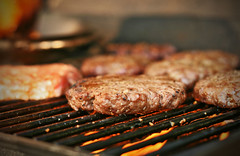
I replicated the cookout experience in my typical, staid office, employing the microwave and toaster to reasonable effect. Based on my co-workers’ looks, I think they’re both puzzled and envious of my burger and dogs.
Barbecues, er, cookouts are tough to plan. It’s hard to know how much stuff to grill, as they’re often informal affairs where uninvited guests have a habit of showing up (including neighbors, tempted by the smell). And people tend to eat more than they say they will.
Plus, there’s the “good provider” instinct that pushes us to serve an abundance of food. And if that’s not enough, for some reason (here are some ideas) hot dogs come in packs of 10, but the buns are sold 8 at a time.
All of that means a lot of extra food. The hosts can hold a microwave and/or toaster cookout the next day (and possibly the day after that, too). Alternately, you can give out doggie bags to guests who want them, as my gracious hosts did. That sparked what I’m sure was a wave of “micro cookouts” in this neck of the woods.
What about you–Any tips for either reducing excess cookout food or making good use of the leftovers?
Comments
11 responses to “Office Cookout”
I’d really like to hear your comments on vegetarianism.
I think the work on this blog is generally great, but I’m in a bit of a conundrum over eating meat while trying to remain as efficient as possible with food production. I’m sure you know the standard arguments: Cattle are not a relatively efficient mode of production of protein, or it takes a lot less water to grow vegetables than to raise animals.
I guess I’m still trying to narrow down your exact ideological reasoning behind this blog. It seems to me that vegetarianism (or freeganism moreso) goes hand-in-hand with not-wasting-foodism.
Hmm…great questions, Paul.
I’m not a vegetarian, but I don’t eat much meat. I do see the logic behind being a vegetarian, both from an environmental and an ethical perspective.
When I do eat meat, I try to appreciate its taste (usually not too hard) and all that went into that meal, including the animal being killed. That appreciation includes not wasting the meat.
On your later question, my ideology isn’t all that complex: With this blog, I’m hoping to get readers to consider and reduce their own food waste. Also to think about how much food waste is built into the food chain. I think wasting food, for the most part, is unnecessary and can be greatly reduced.
I think there’s a real link between freeganism, scrounging or whatever you want to call it and reducing food waste. I see a link between vegetarianism and not wasting, but it’s a bit abstract. I wouldn’t call feeding cattle to create calories a *waste* of grain. I’d call it inefficient.
What were you thinking on the link between vegetarianism and “not-wasting foodism” (we should coin a better phrase for that!)?
In my opinion, vegetarianism, veganism, freeganism, etc. are all individual choices. I see not wasting food as a universal, common sense practice. Maybe that’s why there isn’t an easy -ism for the practice.
Given the right audience, you could start a full scale war with the reference to “Barbecue is a Noun” but I have a feeling those folks aren’t reading Wasted Food. There are a lot of sides to that issue. To me (a daughter of the South), throwing a steak or burger on the fire is “grilling” and “barbecuing” is slow indirect cooking over coals for hours and hours and usually involves a rub or sauce. The resulting product is barbecue, which is a noun. Aren’t you sorry you started this? Whatever you call it, it’s too delicious to waste.
Cookout is a noun, too. . .
The SS–I was more worried that I’d start trouble by writing the words ‘liberal’ and ‘conservative’ in a post (Monday)…Turns out the B word is a bit more controversial!
Jennifer–touché.
The inefficiency of meat production (I’m thinking cattle) is something that drives my personal choices. But, I’m not on an ethics rant. I’m not vegan. I love pizza, and appreciate several things that were delivered to me on truck tires (that tend to have animal products in them). My lifestyle necessitates cattle farms. Veganism is a lifestyle that if taken to it’s logical conclusion, should involve alot more than what you eat, and isolates one from participating in several modes of production.
Not to sound too incindiary, but, here’s a statement has a certain truth (albiet COMPLETELY made up numbers, i dont have time to look up the math) to it:
Eating a 8oz steak is the equivalent of eating 12oz of corn and throwing away an extra 20oz of corn
Point being: it doesn’t matter if you’re the one putting the food in the trash, or if you’re paying someone to maintain an inefficient system of waste.. it’s just as destructive, isn’t it?
I’d love to keep this conversation going.
Well, I think your argument is sound, but it’s the kind of point that will get a lot of people to tune out. I guess I’m more of a realist than an absolutist.
I can see folks thinking that since they can’t directly combat food waste, they may as well not bother. And I don’t think folks will see not eating meat–to let their money do the protesting) as direct action.
Isn’t your statement like (to borrow a phrase) comparing beef to corn? Sure, corn may produce the same amount of calories as beef with way less input, but what about the amount of protein? I’m not sure about the answer, but I think that has to be considered.
Also, we should weigh the impact that modern corn farming’s reliance upon petroleum-based fertilizer and pesticides has on the soil/water. Not to say that the beef industry doesn’t have an environmental footprint, but just that these things need to be included.
It’s a really interesting question–I hope others will weigh in.
On a lighter note: For non-ideological reasons, I’m very happy that I won’t be eating a hamburger or hot dog for the first time in four days.
A few non-sequitors:
1. It seems like the only feasible way to reduce our collective footprint is to establish markets where locally grown produce is the norm.
2. I totally agree with you: When discussing food efficiency and production, we should really talk about protein, not calories. So, comparing “beef to corn” isn’t a good idea, but comparing “beef to beans” is absolutely fine in my eye (and my belly).
3. A lot of the soil used for feed-corn isn’t nutrient-rich enough to grow corn that humans would like to eat. There is alot of reasoning behind how land is used in farming, and I don’t think the problem with food inefficiency begins here.
4. I have serious issues with the contemporary green “movement” (or can we just call it a marketing trend now). I think your writing avoids the traps of this, and that’s a reason i really like this blog.
We certainly did wander off topic on this one, didn’t we? The question was: Any tips for either reducing excess cookout food or making good use of the leftovers?
Leftover grilled steak: slice thin and make a “steakhouse salad”. Leftover pulled pork: wrap in a flour tortilla with some jack cheese, green salsa and guacamole. Leftover hot dogs: slice and make your own “beanie weenies”. Leftover hamburger patties: Can’t you count?
Little known fact about Las Vegas: one of the early residents, Bill Tomiyasu, grew and sold asparagus.
The vegetarian vs. omnivore issue is a great deal more complex than most would like to admit. One has to consider several things (this is long but I wanted to address what seemed of interest):
1. Quality of the rangeland. Historically, food animals are pastured on land too rocky, poor, hilly, or otherwise inhospitable for growing grains, beans, and produce for direct human consumption.
2. From a biological perspective, most livestock (especially cattle) are not evolved to consume grain and soybeans–physiologically, their digestive system cannot handle the massive amount of grain and soybeans. They eat pasture plants (forbs and grasses). Grain-feeding leads to digestive problems, as well as other health issues that lead to use of more antibiotics. Therefore, feeding grain and soybeans to livestock is for profit and convenience. This is one of the major reasons behind seeking out 100% grass-fed livestock (local and small-scale, too :] ).
3. Proper ecosystem functioning (from which we depend on our food production) is dependent on interactions between animals and plants because it is those interactions that ensure effective recycling of all nutrients (no waste). Separation of production of animal and plant foods has led to a massive amount of waste in BOTH areas. Large-scale, industrial agriculture of plants for direct human consumption is just as damaging and wasteful as large-scale, industrial livestock farming. Both involve oil-based fertilizers, chemicals, and transport. Scientific research supports the hypothesis that local, small-scale, “organic” (a label with a lot of controversy, but meant here as not based on petroleum products and heavy use of pesticides), and mixed product farming is more productive, healthful, and environmentally friendly than our current system.
4. Humans, while highly adaptable, have the physiology and anatomy that is best suited to consuming a mixed plant and animal diet. The adaptability of humans allows a small percentage of people to thrive on a vegan diet (assuming proper supplementation for nutrients not available from plants, like B12), a small number to thrive on almost an entirely animal diet (e.g., Eskimos and a couple of African tribes), and most people to be somewhere in the middle. One could argue that it is not right for one person to say they can use Earth’s resources to produce their food, but another cannot.
5. Protein from meat and from plants is different. An increase in the consumption of animals is what allowed the dramatic and rapid advancements (intelligence and civilization) of humans. Animals, while higher on the food and energy chain, are a more concentrated source of proteins and fats (nutrients and energy). Part of this is because humans can extract about 70-90% of protein from animal food, but only 40-70% from plant food. If said animals are feeding on plants not edible to humans, then it is not “cheaper” for humans to feed lower on the food chain. Moreover, feeding mostly or exclusively on plants means having to consume a lot more food to obtain the same nutrients and energy–especially if one is not obtaining most of their calories from grains and beans. Currently, about 1/3 of the land surface is used for human food production. Grains and beans did not become a significant part of the human diet until the last several thousand years–well after the human digestive system and anatomy developed on a diet of about 65% animal and 35% plant (before this starts a major argument, these numbers are based on anthropological studies of extinct human tribes as well as tribes before they came in significant contact with “Western Peoples”; and see Point 4). This has led some to suggest that humans should not be basing most of their caloric intake on grains and beans–especially those who suffer from celiac and related diseases. I am not suggesting that everyone should go back to that percentage or give up grain, but it is important to recognize that animals as food is has a very important role in human health–even in small amounts. Oh, and let’s not forget that entomophagy (eating “bugs”) was/is common throughout human history and in many modern cultures. Now wouldn’t that be an interesting thread? :]
6. One can argue that 6 billion people is at least 3 billion people more than can be comfortably sustained on Earth (while leaving room for other animals and plants to make a living). By comfortably sustained, I refer to having a reasonable high standard of living that includes an omnivore diet, clean water, and the things that make for a comfortable lifestyle.
7. When it comes to wasting food, it is no better to waste plant food than animal food. We could all stand to remember that throughout most of human history, people made use of ALL their food (plant or animal) in some way or another. Only within the last 50 years or so have we become so incredibly wasteful of such an important resource. Many Americans can benefit from eating less meat and other animal products (and junk food)–but then, many Americans could benefit from eating less food period (and more fruits and vegetables). Plant or animal, anything deemed not edible should be composted to remain in the biogeochemical cycles rather than buried. Also, eating less (but still sufficient to meet nutrient and energy needs) and wasting less not only means less land taken for human food production, but also potentially less conflict/war during food shortages (due to a larger cushion).
These are just a few of the issues that need to be considered. Disclaimer: I am a happy, healthy omnivore that (1) endeavors to not be wasteful of any food–plant or animal, (2) is working on composting what is “wasted” (hard to do in an apartment with no porch of any kind), and (3) thinks everyone should eat a diet that enables them to thrive (i.e., mentally and physically healthy)–be it vegan, freegan, vegetarian, omnivorian, or whatever other -an you come up with.
By the way, I have really enjoyed your blog. It has given me some great ideas and news tidbits for discussions to have in my classroom. Thank you so much.