Seattle Steps Forward

It might feel like any other Monday to you, but it’s a momentous one. After much buildup, Seattle’s mandatory curbside composting begins today!

From now on, Seattleites who live in single family homes must separate their food and yard waste from their regular trash. This organic waste will then be collected weekly in a green bin and composted by Cedar Grove. (Previous, voluntary collection had been every other week.)
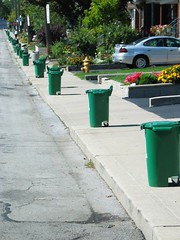
photo by Modern Times via Creative CommonsAs far as I know, it’s the first such case of mandatory food waste collection. Let’s call it compelled composting. And it makes sense that it’s happening in Seattle, which began curbside recycling in 1988.

I like that the city is also employing a carrot: Households have an incentive to reduce their regular garbage because the smaller the container, the less households pay.

The whole thing seems so…enlightened. The city even has a Web site with plenty of tips on food waste collection. The do’s and don’ts are clearly spelled out. As this poster depicts, meats and cheeses can be composted. And finally, no more landfilling of pizza boxes!

Oh, and if you already compost at home, you’re exempt from collection. The city site also provides resources for novice composters on their site.

If there’s one thing I’d like to see changed, it’s getting apartment and condo dwellers involved. Ditto for commercial customers. But all things in due time. For today, let’s just appreciate that there are 30,000 more food waste collection bins in use.

Update: Here’s the local TV news’ coverage of Monday’s changes.


Comments

16 responses to “Seattle Steps Forward”

  1. As far as I know, it’s the first such case of mandatory food waste collection.

    I think you implied it, but you might want to explicitly add “in the United States” or “in North America” because it was pretty common in Germany when I was there seven years ago.

  2. Although I think if one were really nitpicky, you are probably right because the rule only applies to single-family homes, and in the cities I lived in even apartment buildings had bio-waste collection bins.

  3. Good point, tg. I should have specified ‘in the U.S.’

    Generally speaking, the U.S. lags behind Europe in food waste handling.

  4. This is pretty big news. Thanks for bringing it to our attention!

  5. I don’t much like the “mandatory” nature of this requirement. What’s next? The “Trash Police” (apolgies to Leonard Cohen…)? I think it should be voluntary.

    That said, I live in Berkeley where we have had voluntary composting for almost two years (SF and Oakland have had it even longer!), and it is wonderful, awesome, fabulous. I cannot say enough good things about it. You can even compost bones. My solid waste went down by about 2/3 once we started this program, as most of my waste is from cooking debris. All that is left is some packaging, those darn yogurt containers, sanitary stuff, and the cat litter. Sweet!

  6. This is terrific. I wish DC would do something like this. I’ve been working in a restaurant while I job search and I agree that getting restaurants involved needs to be part of the eventual plan. We throw out tons of food that customers don’t finish, and tons of soiled napkins. Aside from the packaging, basically everything thrown out in the kitchen could be composted. I compost and recycle at home. I find that I typically produce less trash in a week that would fill a regular size grocery bag (I try to look at packaging when I shop). I’m also pretty interested in the stuff going on in Boston right now. I was looking at the Green Bin program in Ontario earlier. I noticed that they will accept cat litter, dog and cat waste, and sanitary products, diapers, and incontinence products. http://www.york.ca/services/garbage+and+recycling/green+bin+program.htm

  7. I see that Seattle also offers discounts (and delivery) on rain barrels and compost bins. This is definitely something other cities should consider.
    http://www.ci.seattle.wa.us/util/Services/Yard/Natural_Lawn_&_Garden_Care/BuyCompostBinsRainBarrels/index.htm

  8. I live in Seattle, and we had the “anything” labels applied to our yard waste a few weeks in advance of the deadline. Over the last couple of weeks, the combination of expanded recycling (now including nearly all non-film plastic packaging) and food waste has dramatically reduced our volume and weight of trash.

  9. Diane, I totally get the objection to mandatory recycling of any kind. Part of me feels that it’s too ‘Big Brother.’ But what if your big brother really knew what was best? I’m OK with the move because the time has come. The stakes are high–we’ve only got this here planet.

    Also, Seattle has set high goals for waste diversion that they wouldn’t come close to reaching if composting were voluntary. You’re right that voluntary would only make a dent in the waste stream in extra progressive places like Berkeley. Not that Seattle is apathetic or anything, but it’s no Berkeley.

    Elise, what are you referencing when you say “the stuff going on in Boston?” Converted Organics?
    Glen, keep up the good work. Isn’t it amazing how much less trash there is when you’re composting (and recycling)?!

  10. Converted Organics is cool, but I was thinking of something else. I couldn’t find anything super recent on it (so perhaps it isn’t moving forward), but I was referring to the plans to construct an indoor composting facility that would harvest the methane gas to produce electricity. http://envirowonk.com/content/view/126/1

    I don’t know how efficient this would be, but I’d like to learn more about it.

  11. I think this is fantastic. Kudos to Seattle and let’s hope other cities follow suit.
    When we were in London last year, they did this as a matter of course- one bin was for food waste and compost-like trash. I think it was green.

  12. “But what if your big brother really knew what was best?”

    And who decides what is best?

    Please let me retain the authority in my own property to decide what is trash and what is not.

  13. I get to decide what’s best, class factotum. Just kidding…

    I understand your point of view, but to a certain extent, our elected officials decide what’s best for us in many areas of life. Kind of like how you’re not supposed to put something like antifreeze in with the regular trash.

    I would object to the whole thing more if they were doing random inspections of people’s trash for food. Does anyone know if they’re doing this??

  14. This compost program is for the birds. First, it’s definitely not family friendly. It’s fine if you are single or married without children but if you have a family, its impossible to keep the smelly stuff in your home. It stinks like a garbage dump. We have tried to put the “compost materials” in plastic sacks then transfer the stuff into the little green cart on the curb and throw out the plastic sack into the garbage. This doesn’t work because the compost doesn’t get picked up because an egg carton (which was allowed according to the documentation sent by the city) was still in the compost container. The city says to pack the stuff in news paper then place it into the little green compost container…… great…..Tell the PI. Second, leaving the stuff outside for the raccoons, rats, cats and dogs is not reasonable. Talk about a health hazard !!! Having to clean up after the critters (apparently city owned) is a real drag and a messy one at that. Maybe we should all just leave the stuff in the gutter for the city to clean up. Third, every time we turn around, the City of Seattle is in our pocket. All the city does is to charge more. It is eliminating transportation options by restricting vehicle traffic, plans on squeezing 6 lanes of traffic into a 4 lane tunnel, eliminate auto lanes where thousands of vehicles used to travel for a few bicycles and placing city offices where no parking is available at a reasonable cost. Recently the city lost litigation against it for trying to charge too much for a utility. The city now has to pay the public for the loss but the court jesters and the Emperor have decided to add an extra fee to the utility make up for the loss caused by the court battle. The city wants to have family wage jobs in Seattle and an industrial basis but makes it too expensive to live here. As a result, employees live out side of Seattle and out side of the reach of our Emperor. I suspect Emperor Nichols and his court jesters have now spent hundreds of thousands of tax dollars on a composting project that literally stinks. It seems to me that money like this could be better spent. I hope the Emperor will wake up to the fact that the silent majority is beginning to get ticked. Is there only a few of us that think the controlling city government is overstepping their bounds? Does any body know what we need to do to get some of these ill advised Emperor driven programs changed?

  15. Now the question is what is the consequence for people who fail to follow the new mandate? In Columbus, Ohio (where I live), it is illegal to throw yard waste away in your regular trash can. While the city had free curbside yard waste pickup, I’m sure many people took advantage of it. Now because of the economic downturn, the city had to suspend the free pickup, and it now costs over a hundred dollars a year (and it’s optional to pay for it). I know many people will now unfortunately just throw their yard waste in their regular trash bin (illegally). Without strict consequences to deter people, I just know it will happen.

  16. Beth G. Avatar
    Beth G.

    I also live in Seattle. I LOOOOVVVEEE the new composting/ recycling program, and indeed we have reduced the size of our garbage can to 20 gal for a family of 4, and we have yet to fill it (usually it is about 1/2- 3/4 full). And, we have been worm binning prior (so we were pretty effectively dealing with fruit/vegetable scraps). So I have to disagree with CD that this is not something that a family can do.

    I have heard the argument that CD has used (re: smelly trash). I have to say that I am confused. It seems that before you would have been throwing out those same meat/ bone/ food scraps into the regular trash (or keeping them inside if you were concerned about vermin). How is the new program any different, you simply are putting those things into a different bin? I find it no more onerous or smelly. I am trying to understand this argument so help me see what I am missing.