The Fourth of July Milk Dump

To protest continuously low milk prices, dairy farmers across the nation will spill their milk on the Fourth of July. They’re going to milk their cows, then dump the white stuff on the ground in what will amount to an inland Boston Tea Party.

When I first heard about this plan, I was aghast. Why waste perfectly good milk, I groused, when you could give it away? Then I called Robin Fitch, a N.Y. dairy farmer and one of the leaders in this Fourth of July milk dump.

She assured me that she’d prefer to donate her goods but they can’t because it’s raw milk. And while some people seek that product, it’s illegal to sell. And the people who pasteurize the milk, by and large, are the co-ops and handlers that set the prices that are crushing the growers. Fitch said that for the last one and a half years, most dairy farmers have been getting paid less than the cost of production, driving many out of business.  
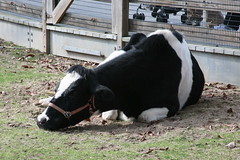
Another idea, simply not milking the cow, isn’t an option because it’d be cruel to the animals. With no OPEC-like twisting the spigot to control supply, Fitch said farmers are doing what they must, but wish they didn’t have to, do.

“Things are real, real desperate. We try to feed our nation, but we can’t put food on our own tables,” said Fitch, who pointed out that most farmers don’t qualify for food stamps and other assistance because their machinery and animals count as assets.

The great American milk dump will happen nationwide. Fitch said she’s heard from farmers from California to Maine. Essentially, whenever they’re done milking their herd on that day, each participating farmer will dump it on their property in front of—hopefully—media members. “I hope this is just a one-day thing. I don’t want to have to do this again,” Fitch said.

This dumping isn’t a novel tactic—U.S. dairy farmers have done it before, as have their European counterparts (I even wrote about that massive Euro-waste). What Fitch hopes is that it’s an effective one.

For all of us non-farmers, Fitch urges pestering our elected officials to support the Specter-Casey bill  (S-1645) which would guarantee farmers get paid at least the national average of what it costs to produce that milk. Doesn’t seem like much.

When I asked her how she refers to the forthcoming milk spill, Fitch said:

I’m calling it ‘the Fourth of July milk dump.’ My husband is calling it ‘the day the farmers take back their independence.’ I also call it absolute craziness. It’s crazy that we’re begging for cost of production.

And I’m calling it ‘just maybe the only instance of food waste I can support.’


Comments

10 responses to “The Fourth of July Milk Dump”

  1. This is great reporting, Jon. I applaud your willingness to challenge your initial assumptions. My first reaction probably would’ve been the same. Interesting stuff.

  2. WilliamB Avatar
    WilliamB

    There are a couple of ways to ensure your dairy farmer gets much of your cost but they’re not available to many of us.

    One is to buy from the dairy. If you want raw milk, you buy into the cow. This means you’re part owner and thus are drinking your own product.

    Two is to buy from a farmers’ market. Gotta be sure it’s a “real” farmers’ market, where the producer is also the seller.

    Oh, there’s option 2.5: some Whole Foods stock dairy direct from the producer. The manager or dairy manager should be able to tell you if your local store does this.

    The problem is #1 is limited availability – it’s not available in many places and even where it is, it’s not available year-round. The problem with #2 and 2.5 is expense – the product is usually organic or better than, and … well, there’s a reason commerical farming is so successful. It really is that much more productive.

    I am not a fan of that bill – the economy gets screwed up when we mess with it too much. Average price is hard to calculate and subject to political and financial manipulation. It’s called “average” for a reason: it covers a range of costs. Some producers will still be underpaid, others overpaid, and rewards for efficiency will be reduced.

    WilliamB,
    who buys milk at farmers’ markets and Whole Foods

  3. Thanks Matt, I’m glad I didn’t just run with my initial assumption.

    I appreciate the well-thought-out response, William. Whether or not you support that bill gets into economic theory a bit, and there are certainly legitimate arguments against such intervention. But they only make sense if, like William, you have another way of supporting farmers. Because otherwise, the small dairy farm is going to disappear. (And Fitch’s farm is definitely a small one.)

  4. Dave Skolnick on Auspicious Avatar
    Dave Skolnick on Auspicious

    Waste is waste. This isn’t right.

  5. Darlene C. Avatar
    Darlene C.

    Waste is waste, that is true. But this is a plea for help from our dairy farmers who dedicate their lives 365 days a year to feed us the consumer. If we keep losing our dairy farms at the rate we are right now we won’t be able to find a gallon of milk. Please tell me what business doesn’t figure their cost of production into the cost of their product.Why shouldn’t our dairy farmers be allowed to figure cost of production into the price they get for their product? We the consumer need to call our elected officals and tell them they need to pass the Specter-Casey bill (S-1645)now!

  6. Dave Skolnick on Auspicious Avatar
    Dave Skolnick on Auspicious

    Sorry Darlene – waste is waste. The Boston Tea Party isn’t a good metaphor for today. It just doesn’t apply. There are other ways to object. Wasting food that people are starving for is simply not a good way.

  7. […] Farmers around the nation dumped milk on the 4th to protest prices that leave them unable to achieve… Read the Article tweetmeme_style = 'compact'; […]

  8. Tracy Avatar
    Tracy

    Sorry Dave, but starvation is not so much an issue of supply as it is distribution. We have enough food to feed everyone on this planet, we just aren’t making sure they all get it.

    And, in fact, I would contend that there was probably just as much starvation during Boston Tea Party times as there is now, and just as many people scoffing at the idea of “wasting” tea.

    And speaking of starvation, we are starving our farmers. Dumping milk is a shocking form of protest. Well, somebody needs to shock the hell out of Americans who don’t understand how much it actually costs to produce food in this country, and how many family farmers we are losing every day.

  9. brian jablonski Avatar
    brian jablonski

    I tottaly agree with the 4th of july dump day. i dont own my own dairy farm and would love to but when you cant cash flow it on paper what do you do when you have the unexpected. i do work on a dairy farm so i do know how these prices are hurting their bottom line. i hope onme day soon milk prices would somewhat catch up to inflation.

  10. Are there no milk subsidies for dairies now in the US? I’m really curious to see if we abolished that system.