A Lesson from Pear Country

I was going through some pictures from this fall and came across this progression. I promise I haven’t doctored the photos in any way.

Below, we see a grower from Oregon’s Hillcrest Orchards illustrating what kind of pears don’t get picked. I asked him how deep certain bruises went and he showed me on one particular pear.

Out comes the paring knife…
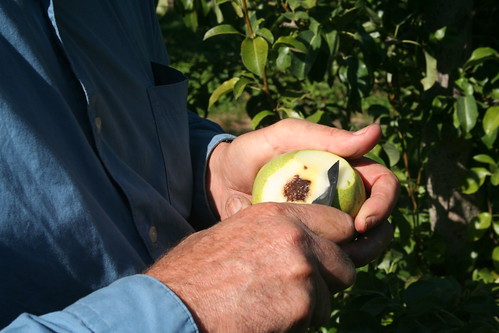
Carve away some more (action shot)…

And, voila!
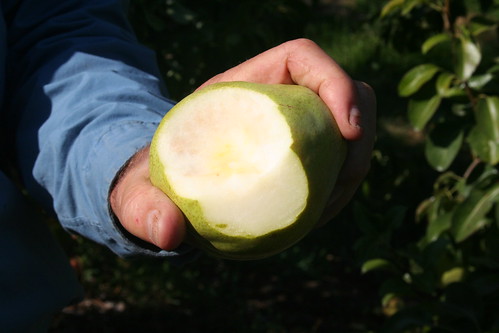
The pics provide some that appearances can be deceiving. A little, or in this case, a lot of bruising, doesn’t mean you have to toss the entire piece of produce.


Comments

5 responses to “A Lesson from Pear Country”

  1. Well, it depends on how long the fruit is going to sit around before it’s consumed. Bruises can mold very quickly, and then the mold spreads to other fruit. When we glean fruit with Village Harvest, we don’t distribute anything with a broken peel, or bruised or too soft.

    But we take all of the culls home ourselves, to make juice or jam or dehydrate. But commercial orchards are operating under different rules and economical realities.

  2. Diana,
    When the Society of St. Andrew delivers gleaned potatoes to us in the fall, they frequently have chunks cut off of them. When Wegmans donates their culled produce to us, often times pieces of fruit and veggies are gussied up with some chunks taken out of them. It’s not only good practice, but perfectly reasonable to take the time to care for culled produce so that it can be used; afterall, when you’re hungry you don’t focus on the bruises on the fruit, but rather the still edible part of the fruit. The idea that it’s somehow acceptable for the largest food producers to waste food is laughable. Those folks have an increased burden to manage their waste streams for social, environmental and economical reasons. When you approach the big guys (and gals) with a clear head, a respectful tone, and an understanding of the law and the tax codes, it’s an easy sell to get in and recover the nutrients and calories that normally rot in the field.
    Peace and Love,
    Dan

  3. Good point, Diana. To clarify: I wasn’t implying that orchards could use these bruised fruit, but that if individuals find produce with some bruising they might be able to use it. It can’t hurt to take out the paring knife and see how deep the bruising goes…

  4. Pears are remarkable in that they more consistently ripen than any other fruit I have regularly eaten, and their bruises are small and do not spread, which is related to the phenomena that they ripen so successfully in the basket on the kitchen counter. Are there other fruits that ripen this well after picking? Are there other fruits that are so bruise resillient?

  5. discount christian louboutin…

    A Lesson from Pear Country…