If I told you that hotels and restaurants could convert their food waste to a down-the-drain liquid in 24 hours, would that interest you?
BioHitech America’s high volume organic waste decomposition system can do just that. Apparently, you dump all of your food waste into the stainless steel contraption (which comes in three sizes and costs G_d knows how much),
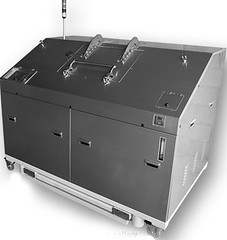
microorganisms (yeasts) break everything down and 24 hours later the liquid byproduct is sent down the drain (to your local water treatment facility).
I haven’t seen this waste-to-water slurry technology in action, but I hope to soon. I do know that it received “grand recognition” at the NY Hotel/Motel and Restaurant Show.
If it does work and was adopted on a widescale, it would greatly reduce greenhouse gas emissions by keeping food out of landfills and garbage trucks off the road. BioHitech America’s marketing manager Kim Doscher said they hope to use the nutrient-rich liquid for fertilizer in the near future while others may use it for animal feed.
There are other companies using this technology, which I believe began in Korea (see the above link). Waste to Water Environmental sells a similar system, Green Key offers a suite and Somat has its eCorect Waste Reducer.
Comments
5 responses to “Down the Drain, in a good way(?)”
But there’s a catch, and a big one at that. The food ecocycle is based on things going round — old food should become new food. The same as in all other recycling programmes — metal to metal, glass to glass, plastic to plastic and even dust to dust.
Obviously we all agree that food waste shouldn’t go to landfill. Next best up the pecking chain is energy recovery — collecting and burning the stuff to warm houses. It’s fine to be warm but not smart to burn what is effectively soil. You can make biogas from food waste (fast-growing industry here in Sweden) and at least you get an alternative fuel from it and a pretty crappy compost-like by-product. But the absolute best is to get it back into the soil where it belongs, with all nutritional value intact. If we do that now we’ll be very grateful in a few years time, it’s only going to go on getting harder to keep producing the amount of food we need on the land we have.
Even in America.
It’s great you’re looking into this though, it’s a hidden area that we’ve just not been thinking about anywhere near enough. Out of sight out of mind and all that. Keep up the good work!
/JennyH
Jon,
I called them up, and they’re faxing me over an info packet on their line of products (hopefully, with prices included). I about cracked up over the phone when I said, “I hear you guys have a machine that turns food waste into a slurry that I can wash down the drain,” and when I said the word “slurry” she corrected me, “well, it turns it into water.” HA! I prefer slurry.
Jenny,
Actually, while you’re right that the next best thing in the chain is energy recovery, burning the food waste isn’t actually recovering the energy in the most efficient way. The next link in the chain would be feeding it to hungry people, then to animals, then towards those industrial uses (like burning it or turning it into some sort of sculpture). Composting food waste finishes as a next-to-last option with dumping it into a landfill, because the energy represented in that food isn’t just the sun and the earth nourishing the plant to bear fruit, but there is also a fair amount of human labor involved in nurturing and harvesting food from the earth. Any of that energy you can put back into people, or into animals to feed people is going to help you recover more of what you stand to lose.
We’re all happy that these things would keep food out of the landfills. That minimizes one problem. But sending nutrient-rich anything down the drain misses an opportunity, as Jenny mentions.
What should happen next is just a matter of perspective. I’m with Dan in following that EPA hierarchy of feeding people. That means diverting as much edible stuff to the hungry as possible. But you’ll always have inedible stuff. So then what?
As far as I understand it, these waste-to-liquid solutions don’t burn anything. It’s a digestion process, only there’s no energy output. The upshot is that you *could* get a fertilizer instead of a less valuable compost byproduct. That’s why I’m hoping instead of sending the nutrient-rich slurry/water(!) down the drain, they begin using it as a fertilizer. Anyway…we shall see!
Oooh, the fertilizer option sounds like the best!
It is interesting and encouraging to read about various people coming up with solutions that will prevent organic waste from going into landfill.
I am the CEO of an Australian company with technology that converts organic waste [ food and plants ] into pelletised animal feed for pigs and poultry.
Last year we had a pilot test project in a South East Asian Municipality where we proved the technology, by producing several kilos of chicken feed.
The system is simple, foolproof, very cost effective, and once implemented would solve the waste disposal problems of all Municipalities struggling with millions of waste going to landfill.
Do you know how many Plants we have built ? None.
Why ? Simple. Municipalities in developing countries have the biggest waste disposal problems, and the leaset money to fix it.
One thing is clear; there is an enormous range of options available out there that will guarantee that no organic waste will go into landfill.
There is simply no money, or will, to do something about it.